
One encoder for motion and skeleton data
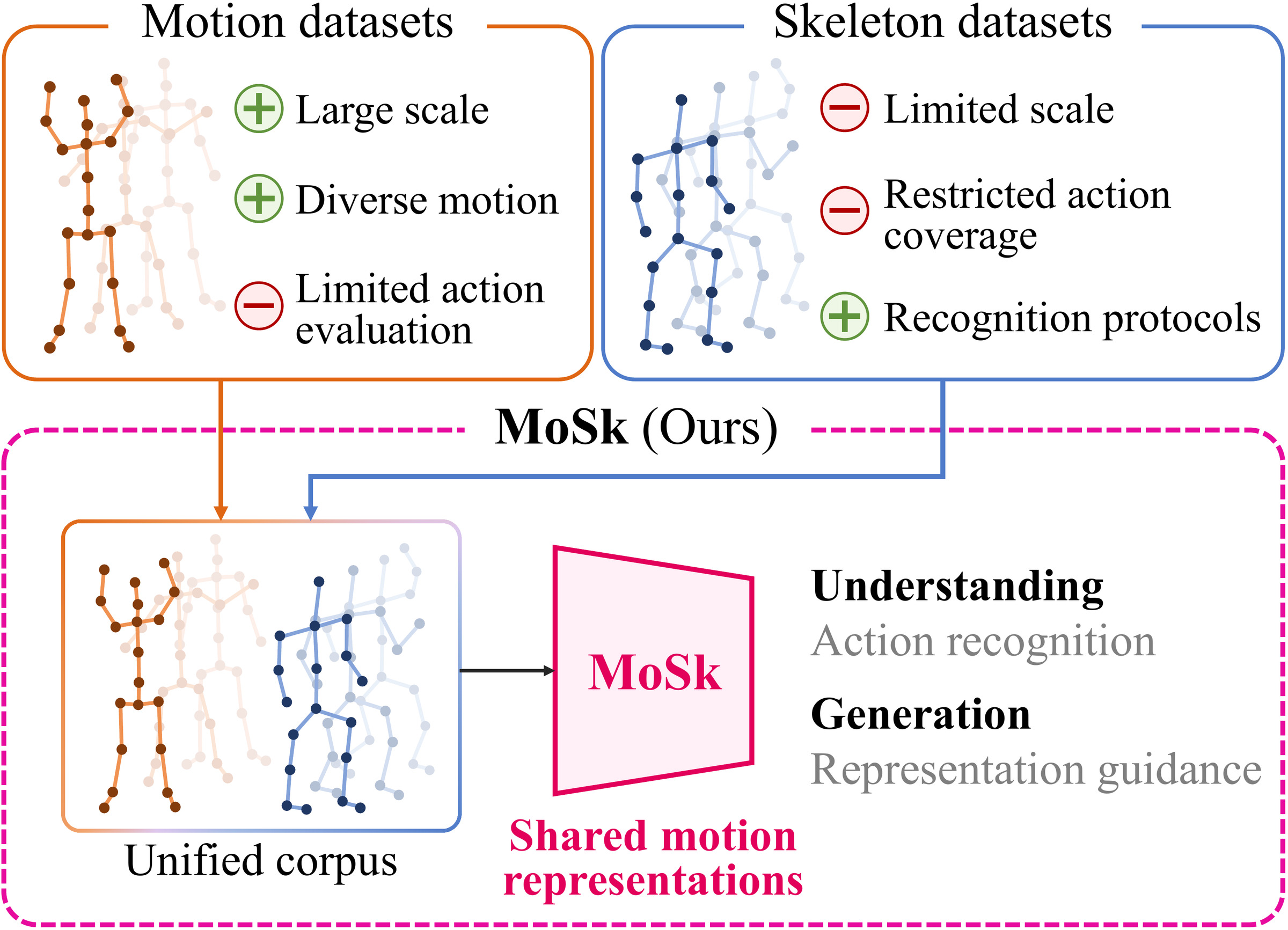
Trained without labels or captions on 1.47M clips from four motion and three skeleton datasets, then used for action recognition and for guiding motion generation.
| Dataset | Annotation | Clips | Hours |
|---|---|---|---|
| Motion (SMPL, 22 joints / KIT, 21 joints) | |||
| HumanML3D | text | 12,326 | 24.2 |
| KIT-ML | text | 3,386 | 10.4 |
| MotionMillion | text | 595,422 | 819.6 |
| RoMo | text | 766,864 | 1,166.2 |
| Skeleton (Kinect v2, 25 joints) | |||
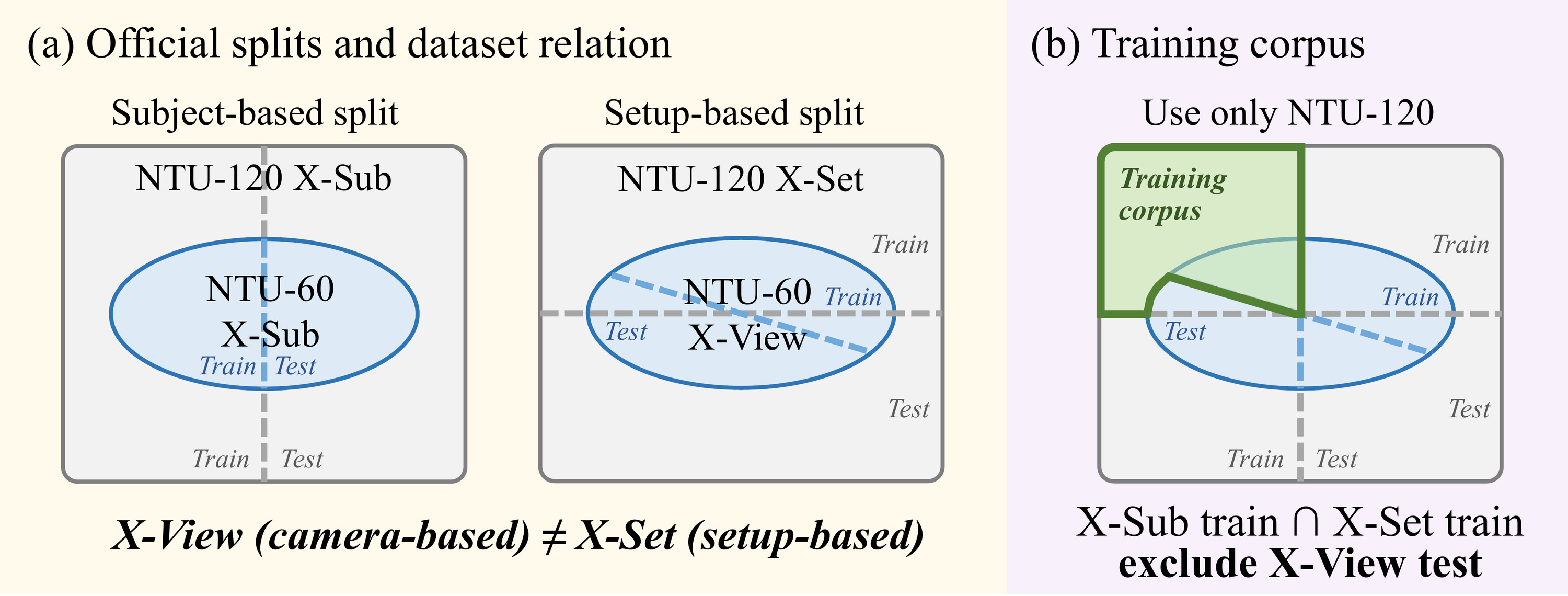
| NTU RGB+D 60 / 120 | 120 actions | 18,757 | 12.8 |
| PKU-MMD II | 41 actions | 728 | 5.7 |
| ETRI-Activity3D | 55 actions | 67,622 | 136.4 |
| Total (3 formats) | 1,465,105 | 2,175.4 | |
Kinect v1 and OpenNI formats are excluded from training and kept for unseen-format evaluation.
Paper figures
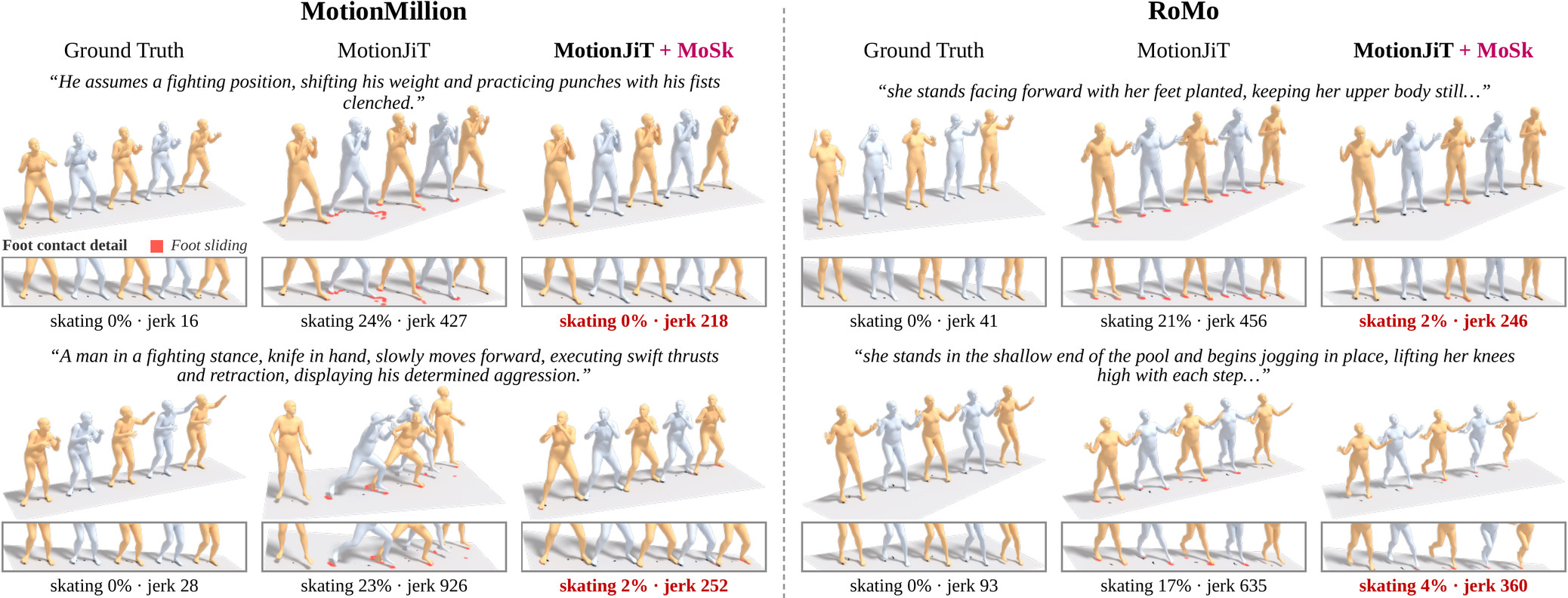
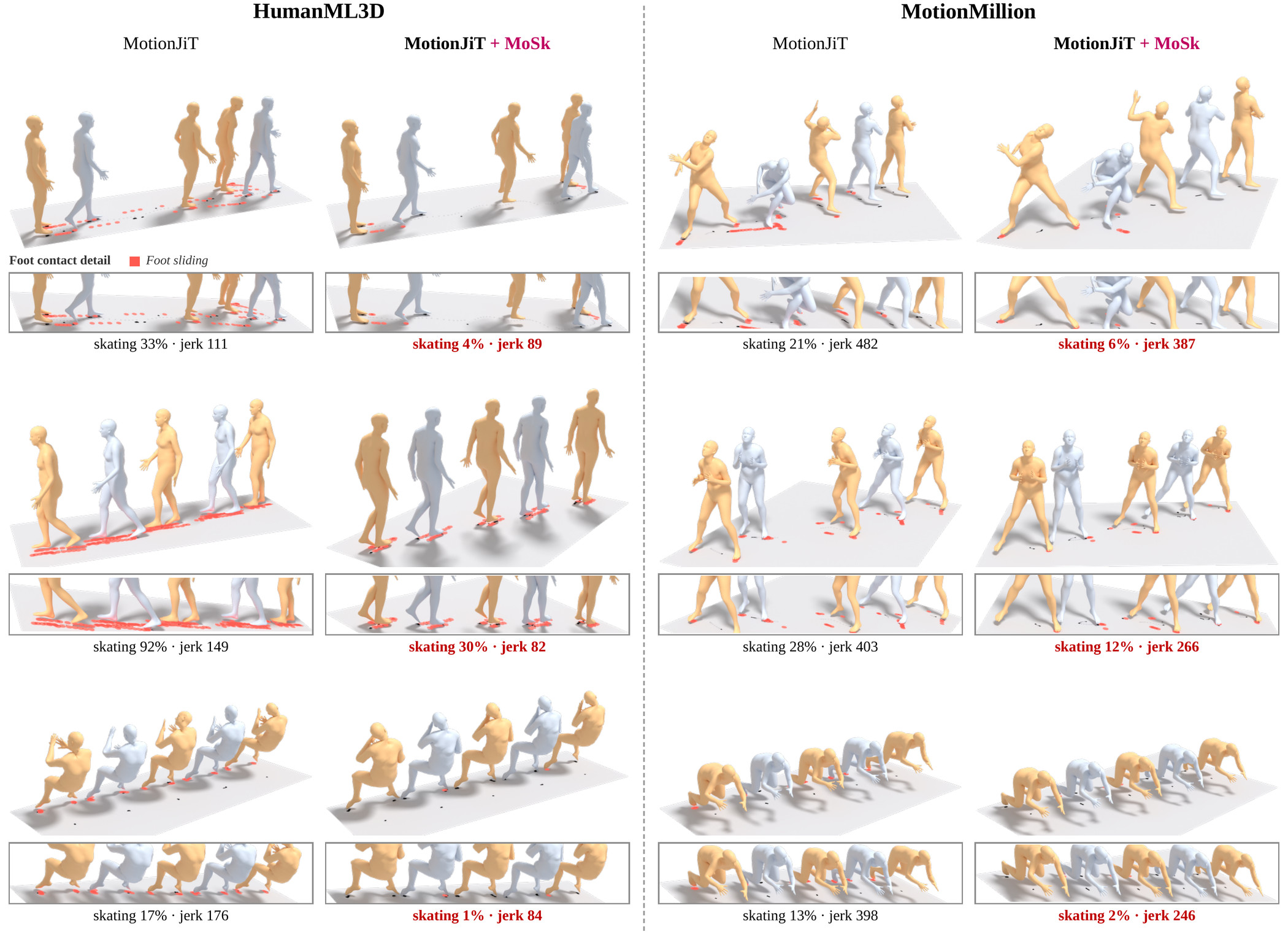
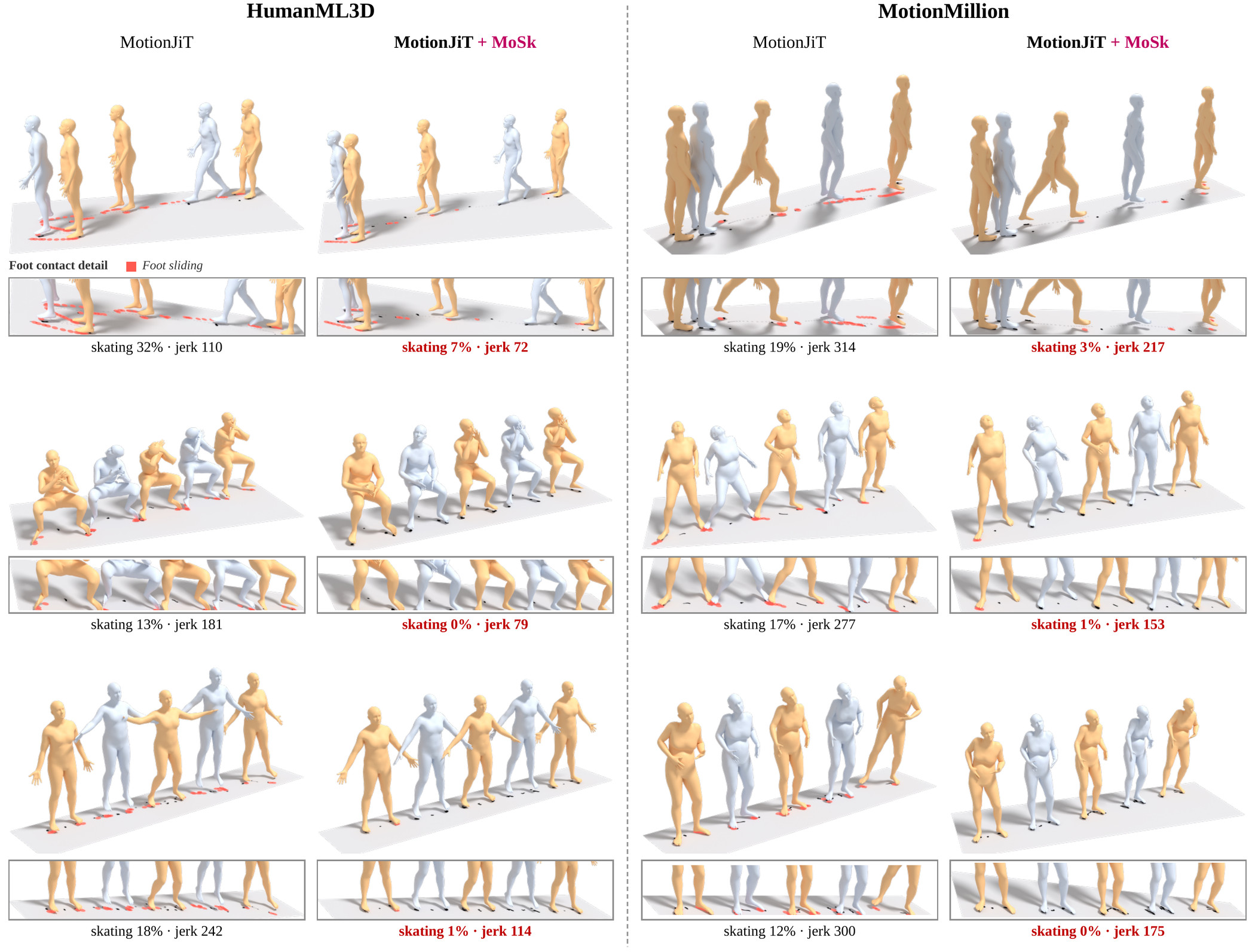
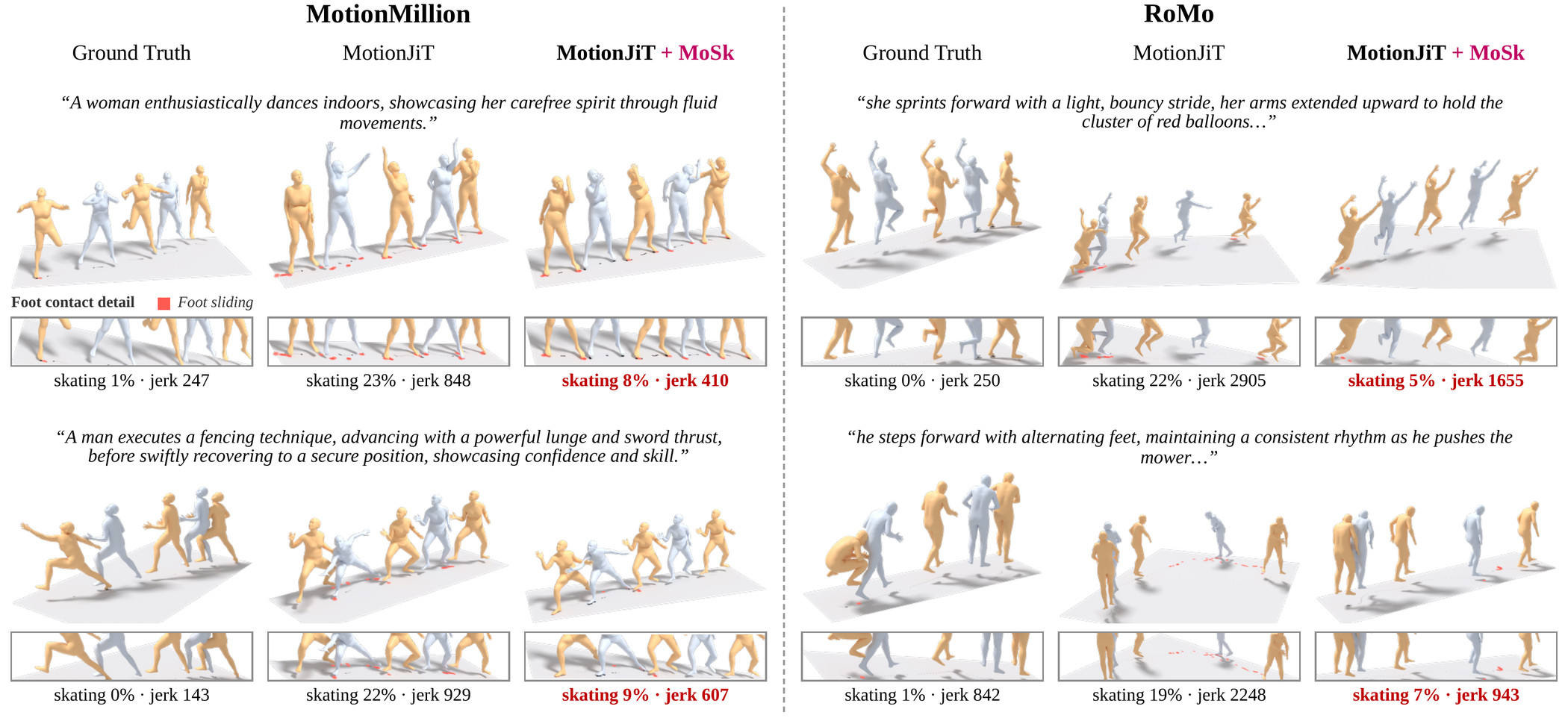
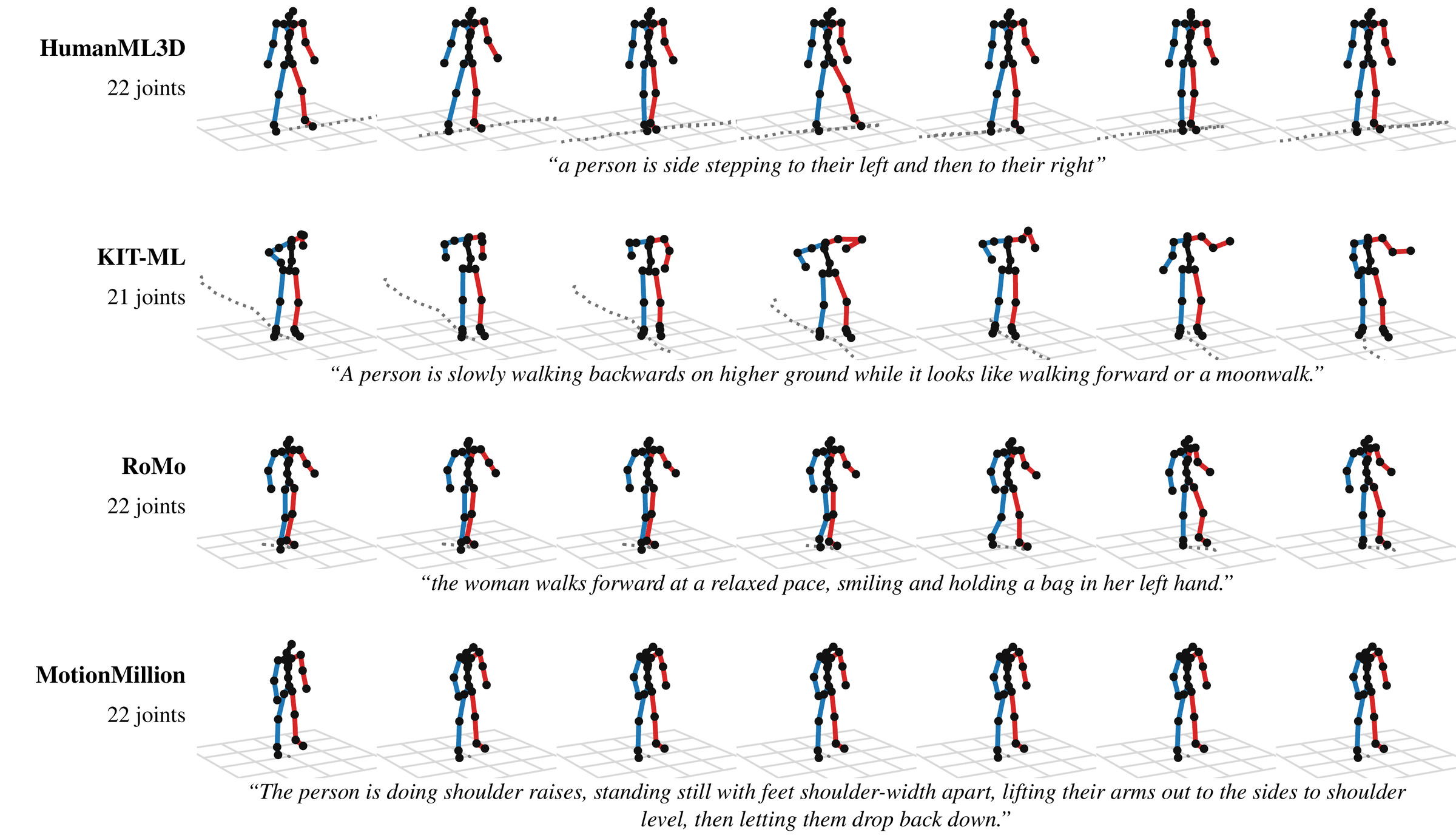
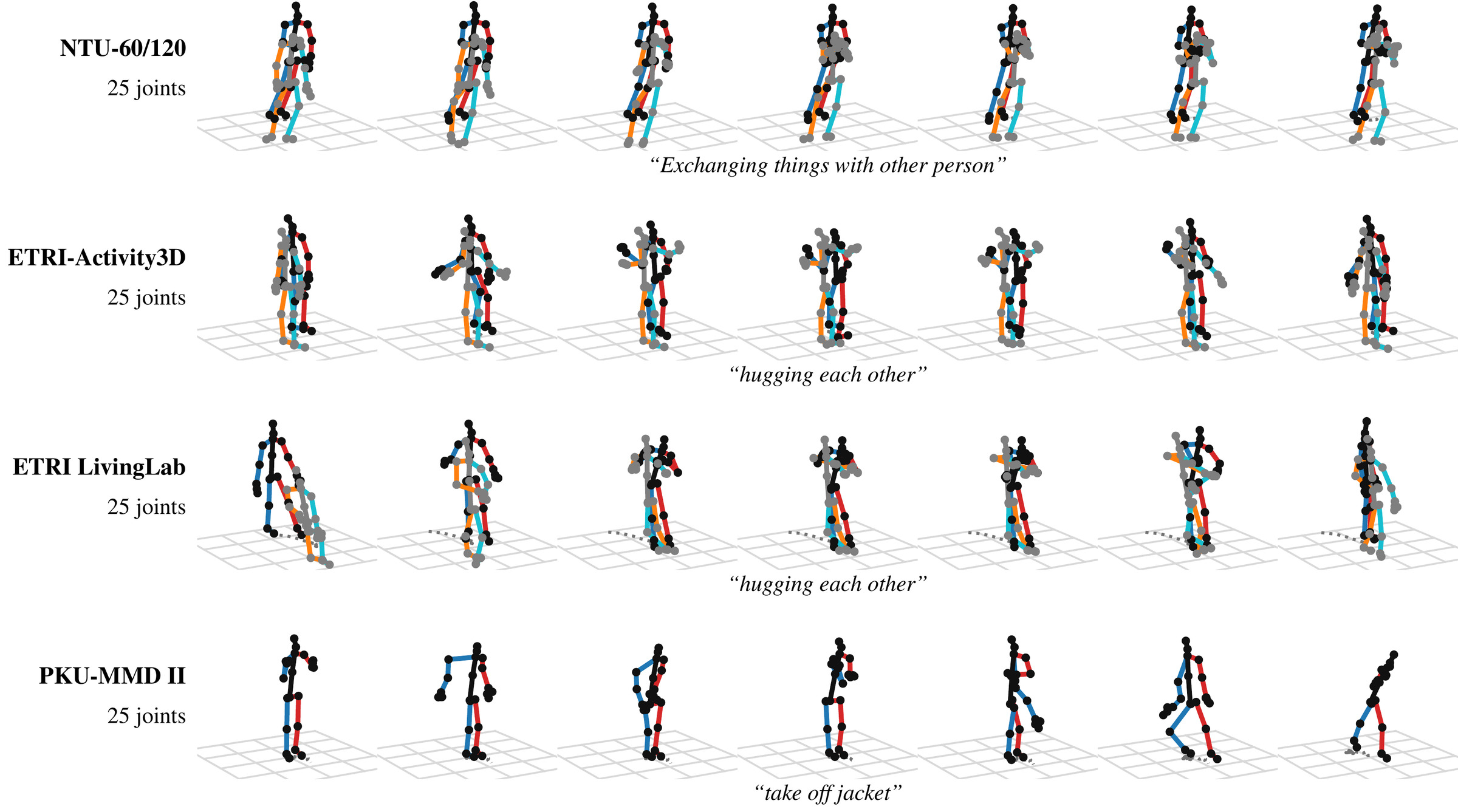
Generation with and without MoSk alignment, the leakage-free NTU training corpus, and the standardized inputs of every dataset.
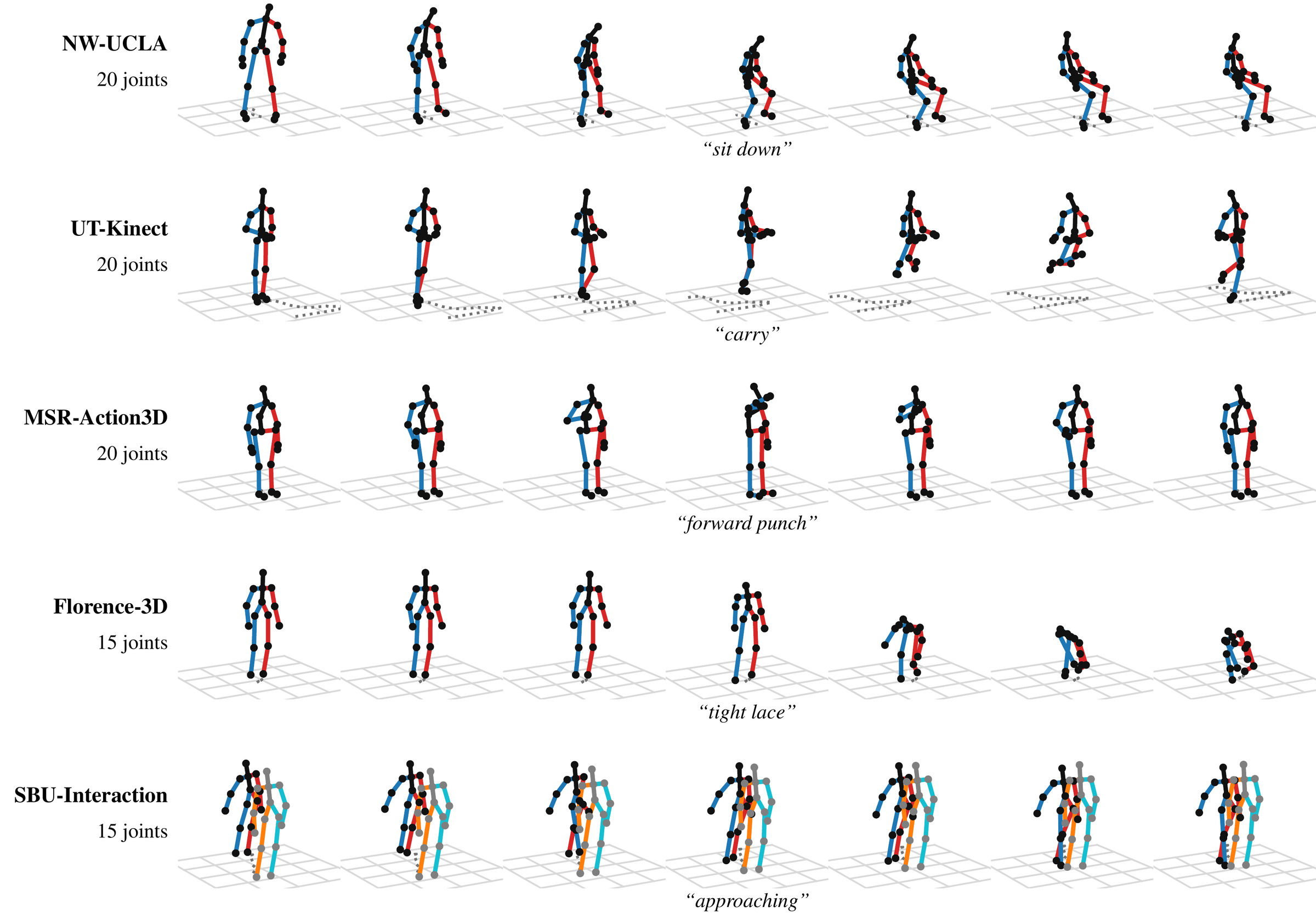
Dataset conversion Table 13
| Dataset | Layout (joints) | Up direction and floor | Native fps |
|---|---|---|---|
| NTU-60/120 | Kinect v2 (25) | Floor plane per setup and camera | 30 |
| ETRI-Activity3D, LivingLab | Kinect v2 (25) | Floor plane per tracked sensor session | 30 |
| PKU-MMD II | Kinect v2 (25) | Floor plane per camera session | 30 |
| NW-UCLA | Kinect v1 (20) | Floor plane per view and subject | 15 |
| UT-Kinect | Kinect v1 (20) | One floor plane for the static camera | 30 |
| MSR-Action3D | Kinect v1 (20) | Ankle-to-shoulder axis, floor at lowest foot | 15 |
| Florence-3D | OpenNI (15) | Spine axis, floor 7 cm below median lowest ankle | 20 |
| SBU-Interaction | OpenNI (15) | Spine axis, floor 7 cm below median lowest ankle | 15 |
| HumanML3D | SMPL (22) | Provided | 20 |
| KIT-ML | MMM (21) | Provided | 7.5 / 12.5 / 15 |
| RoMo | SMPL (22) | Provided, with 0.156 m floor offset removed | 30 |
| MotionMillion | SMPL (22) | Provided | 30 |
Every clip is stored as 3D joint positions in meters with +y up and the floor at y = 0, keeping the source joint layout; windows are resampled to 20 fps at load time.
Quantitative results
94.0% on NTU-60 X-View and 69.4% on PKU-MMD II with a frozen encoder, 77.0% on NTU-60 X-Sub with 1% of the labels, and lower FID in 15 of 16 generation settings.
| Method | Venue | Linear evaluation | Semi-supervised (NTU-60) | |||||||
|---|---|---|---|---|---|---|---|---|---|---|
| NTU-60 | NTU-120 | PKU-MMD II | X-Sub | X-View | ||||||
| X-Sub | X-View | X-Sub | X-Set | X-Sub | 1% | 10% | 1% | 10% | ||
| Sensor-specific representation: one model per dataset | ||||||||||
| MAMP | ICCV'23 | 84.9 | 89.1 | 78.6 | 79.1 | 53.8 | 66.0 | 88.0 | 68.7 | 91.5 |
| SCD-Net | AAAI'24 | 86.6 | 91.7 | 76.9 | 80.1 | 54.0 | 69.1 | 82.2 | 66.8 | 85.8 |
| S-JEPA | ECCV'24 | 85.3 | 89.8 | 79.6 | 79.9 | 53.5 | 67.5 | 88.4 | 69.1 | 91.4 |
| MacDiff | ECCV'24 | 86.4 | 91.0 | 79.4 | 80.2 | – | 65.6 | 88.2 | 77.3 | 92.5 |
| USDRL | AAAI'25 | 85.2 | 91.7 | 76.6 | 78.1 | 54.4 | 57.3 | 80.2 | 60.7 | 84.0 |
| GFP | ICCV'25 | 85.9 | 92.0 | 79.1 | 80.3 | 56.2 | 71.8 | 88.7 | 72.9 | 92.1 |
| STARS | WACV'26 | 87.1 | 90.9 | 79.9 | 80.8 | 52.7 | 69.1 | 88.0 | 72.9 | 91.8 |
| AMR | CVPR'26 | 87.4 | 92.3 | 81.1 | 81.9 | 60.3 | 72.2 | 89.0 | 74.4 | 92.7 |
| DiMoP | TBIOM'26 | 86.8 | 91.9 | 80.7 | 81.8 | – | 70.1 | 88.4 | 71.2 | 92.3 |
| Path-JEPA | ECCV'26 | 87.6 | 92.9 | 81.5 | 81.8 | 56.7 | 72.2 | 89.1 | 71.8 | 92.1 |
| SLiM | NeurIPS'26 | 87.9 | 93.2 | 81.2 | 83.6 | 59.7 | 72.1 | 88.8 | 75.8 | 91.9 |
| Sensor-unified representation: skeleton data | ||||||||||
| SOfA | arXiv'26 | 87.0 | 92.6 | 79.5 | 82.0 | 67.1 | 71.6 | – | 74.2 | – |
| Motion-skeleton unified representation | ||||||||||
| MoSk (skeleton data only) | – | 87.2 | 93.4 | 78.8 | 81.8 | 67.8 | 77.8 | 90.7 | 79.4 | – |
| MoSk (motion data only) | – | 80.0 | 86.4 | 69.4 | 72.3 | 56.0 | 59.5 | 87.0 | 61.1 | – |
| MoSk (Ours) | – | 88.5 | 94.0 | 81.1 | 83.3 | 69.4 | 77.0 | 91.4 | 78.1 | 95.4 |
MoSk is best on both NTU-60 protocols and on PKU-MMD II, and in all four semi-supervised settings; with 1% of the labels on NTU-60 X-Sub it is 4.8 points above AMR and Path-JEPA. SOfA uses a filtered X-View test subset. Best and second best exclude the skeleton-only and motion-only variants.
| Method | Kinect v1 (20 joints) | OpenNI (15 joints) | ||
|---|---|---|---|---|
| MSR-Action3D | UT-Kinect | Florence-3D | SBU-Interaction | |
| Fully supervised, target skeleton seen (reference, not ranked) | ||||
| Best reported | 84.5 | 96.5 | 94.4 | 98.5 |
| Sensor-specific representation | ||||
| SkeletonMAE | – | – | 66.8 | 73.1 |
| MAMP | – | – | 73.7 | 80.2 |
| Sensor-unified representation (skeleton data) | ||||
| SOfA | 82.2† | 97.0† | 91.7 | 97.0 |
| Motion-skeleton unified representation | ||||
| MoSk (Ours) | 81.0 | 98.0 | 96.5 | 94.8 |
† Dataset included in SOfA’s pre-training data. SkeletonMAE and MAMP results are from SOfA. MoSk exceeds the fully supervised references on UT-Kinect and Florence-3D, and improves on SOfA by 4.8 points on Florence-3D.
| Method | Venue | NTU-60 | NTU-120 | NW-UCLA | ||
|---|---|---|---|---|---|---|
| X-Sub | X-View | X-Sub | X-Set | X-View | ||
| Fully supervised, target skeleton seen (reference, not ranked) | ||||||
| SkateFormer | ECCV'24 | 93.5 | 97.8 | 89.8 | 91.4 | 98.3 |
| ProtoGCN | CVPR'25 | 93.8 | 97.8 | 90.9 | 92.2 | – |
| Hyper-GCN | ICCV'25 | 93.7 | 97.8 | 90.9 | 92.0 | 97.6 |
| Gamba | CVPR'26 | 93.4 | 97.3 | 90.1 | 91.9 | 97.3 |
| Sensor-specific representation | ||||||
| SkeletonMAE | ICMEW'23 | 86.6 | 92.9 | 76.8 | 79.1 | – |
| MotionBERT | ICCV'23 | 93.0 | 97.2 | – | – | – |
| MAMP | ICCV'23 | 93.1 | 97.5 | 90.0 | 91.3 | – |
| MacDiff | ECCV'24 | 92.7 | 97.3 | – | – | – |
| STARS | WACV'26 | 93.0 | 97.5 | 89.9 | 91.4 | – |
| Motion-skeleton unified representation | ||||||
| MoSk (no pre-training) | – | 84.5 | 94.5 | 78.1 | 81.6 | 84.9 |
| MoSk (Ours) | – | 94.1 | 98.7 | 90.3 | 92.4 | 97.2 |
MoSk surpasses the fully supervised multi-stream references on both NTU-60 protocols and NTU-120 X-Set. Without self-supervised pre-training, the same architecture is 4.2–12.3 points lower.
| Alignment | Unconditional generation | Text-to-motion generation | ||||||||||
|---|---|---|---|---|---|---|---|---|---|---|---|---|
| MotionJiT | MotionPiT | MotionJiT | MotionPiT | |||||||||
| FID∅↓ | Skate↓ | Jerk↓ | FID∅↓ | Skate↓ | Jerk↓ | FID↓ | R@1↑ | MM-Dist↓ | FID↓ | R@1↑ | MM-Dist↓ | |
| HumanML3D | ||||||||||||
| None | 0.692 | 0.168 | 139 | 0.326 | 0.114 | 119 | 0.052 | 0.575 | 2.65 | 0.050 | 0.571 | 2.68 |
| + MoSk (Ours) | 0.461 | 0.133 | 97 | 0.310 | 0.110 | 96 | 0.046 | 0.575 | 2.64 | 0.049 | 0.573 | 2.66 |
| KIT-ML | ||||||||||||
| None | 1.667 | 0.276 | 75 | 1.512 | 0.261 | 80 | 0.215 | 0.446 | 2.74 | 0.147 | 0.461 | 2.56 |
| + MoSk (Ours) | 1.322 | 0.272 | 70 | 1.297 | 0.265 | 68 | 0.218 | 0.454 | 2.70 | 0.139 | 0.464 | 2.63 |
| MotionMillion | ||||||||||||
| None | 71.71 | 0.114 | 314 | 64.31 | 0.085 | 318 | 32.19 | 0.800 | 23.87 | 30.79 | 0.809 | 23.69 |
| + MoSk (Ours) | 61.96 | 0.095 | 248 | 62.95 | 0.085 | 261 | 28.36 | 0.813 | 23.53 | 26.97 | 0.814 | 23.54 |
| RoMo | ||||||||||||
| None | 15.35 | 0.139 | 472 | 7.79 | 0.083 | 496 | 17.35 | 0.431 | 33.03 | 17.33 | 0.433 | 33.04 |
| + MoSk (Ours) | 9.68 | 0.092 | 371 | 6.44 | 0.073 | 423 | 15.27 | 0.435 | 32.98 | 15.31 | 0.436 | 33.00 |
Alignment lowers unconditional FID and jerk in all eight dataset–backbone pairs, by up to 9.75 FID on MotionMillion, and text-to-motion FID by up to 3.83. MoSk is used only during training, so inference cost is unchanged.
Action recognition uses joint coordinates only and reports top-1 accuracy. Generation compares each backbone with and without alignment to the frozen MoSk encoder under matched training schedules. Unless a variant is named, MoSk is the default MoSk-L encoder (24 layers, width 1024, 304M parameters; Table 10).
Ablations Tables 6 and 7
| pK | Mixture | Understanding | Generation | |||||||
|---|---|---|---|---|---|---|---|---|---|---|
| Skel. | Motion | NTU-60 | NTU-120 | PKU-MMD II | ETRI-Act | NW-UCLA | FID∅↓ | FID↓ | R@1↑ | |
| No REPA alignment with MoSk | 0.692 | 32.19 | 0.800 | |||||||
| 100% | 138× | 0.0× | 87.2 | 78.8 | 67.8 | 88.0 | 95.9 | 0.498±0.037 | 28.19±1.20 | 0.811±0.000 |
| 80% | 110× | 2.1× | 88.5 | 81.1 | 69.4 | 89.7 | 94.2 | 0.461±0.049 | 28.36±0.28 | 0.813±0.000 |
| 50% | 69× | 5.3× | 88.3 | 81.0 | 69.5 | 89.0 | 93.8 | 0.518±0.038 | 28.92±0.20 | 0.810±0.002 |
| 20% | 28× | 8.4× | 86.9 | 79.1 | 64.5 | 87.7 | 95.3 | 0.466±0.043 | 28.48±0.66 | 0.809±0.002 |
| 0% | 0× | 10.6× | 80.0 | 69.4 | 56.0 | 82.3 | 90.9 | 0.454±0.043 | 27.30±0.63 | 0.813±0.003 |
Compared with skeleton-only training, adding motion data at pK = 80% improves recognition on NTU-60, NTU-120, PKU-MMD II and ETRI-Activity3D; motion-only training gives the lowest mean FID. pK = 80% is the default.
| Encoder | Decoder | Seen | Unseen | Avg. | |||
|---|---|---|---|---|---|---|---|
| Anatomy | Side | Anatomy | Side | Jk = 25 | Jk = 20 | Jk = 15 | |
| ✓ | ✓ | ✓ | ✓ | 71.5 | 87.7 | 92.1 | 82.7 |
| ✓ | ✗ | ✓ | ✓ | 71.3 | 86.5 | 91.1 | 82.0 |
| ✗ | ✓ | ✓ | ✓ | 71.5 | 87.1 | 91.0 | 82.2 |
| ✗ | ✗ | ✓ | ✓ | 70.7 | 86.4 | 89.2 | 81.2 |
| ✓ | ✓ | ✓ | ✗ | 71.0 | 86.6 | 91.4 | 82.0 |
| ✓ | ✓ | ✗ | ✓ | 70.7 | 86.8 | 91.8 | 82.0 |
| ✓ | ✓ | ✗ | ✗ | 70.5 | 87.5 | 90.0 | 81.8 |
| ✗ | ✗ | ✗ | ✗ | 71.2 | 87.8 | 91.1 | 82.4 |
| No random joint drop | 71.3 | 86.5 | 91.0 | 81.9 | |||
| Random masking only | 71.6 | 86.5 | 91.4 | 82.1 | |||
| Semantic-tube masking only | 69.8 | 86.5 | 91.5 | 81.5 | |||
| Raw sequence X as target | 63.1 | 83.4 | 87.7 | 76.8 | |||
Predicting frame-to-frame displacement instead of raw coordinates has the largest effect (+5.9 points on average). Component ablations use MoSk-S, a smaller encoder variant (Table 10).
Encoder scale and clip length Tables 10 and 11
| Variant | Encoder | Understanding | Generation | ||||||||
|---|---|---|---|---|---|---|---|---|---|---|---|
| Layers Le | Width D | Params. | NTU-60 | NTU-120 | PKU-MMD II | ETRI-Act | NW-UCLA | FID∅↓ | FID↓ | R@1↑ | |
| No REPA alignment with MoSk | 0.692 | 32.19 | 0.800 | ||||||||
| MoSk-S | 8 | 256 | 6.6M | 81.9 | 72.5 | 60.1 | 85.4 | 91.4 | 0.422±0.066 | 28.63±0.02 | 0.809±0.003 |
| MoSk-M | 12 | 768 | 86M | 87.6 | 79.8 | 67.1 | 88.2 | 94.6 | 0.432±0.011 | 27.61±0.22 | 0.813±0.003 |
| MoSk-L | 24 | 1024 | 304M | 88.5 | 81.1 | 69.4 | 89.7 | 94.2 | 0.461±0.049 | 28.36±0.28 | 0.813±0.000 |
| MoSk-XL | 32 | 1280 | 631M | 88.2 | 80.4 | 69.6 | 90.4 | 95.5 | 0.458±0.042 | 27.87±1.29 | 0.813±0.001 |
MoSk-L is best on NTU-60 and NTU-120; MoSk-XL leads on PKU-MMD II, ETRI-Activity3D and NW-UCLA. MoSk-S and MoSk-M give the lowest mean FID for unconditional and text-to-motion generation, respectively.
| Sampled frames | Understanding | Generation | ||||||
|---|---|---|---|---|---|---|---|---|
| Training | Inference | NTU-60 | NTU-120 | PKU-MMD II | ETRI-Act | NW-UCLA | FID∅↓ | FID↓ |
| No REPA alignment with MoSk | 0.692 | 32.19 | ||||||
| 64 | 64 | 88.5 | 81.1 | 69.4 | 89.7 | 94.2 | 0.461±0.049 | 28.36±0.28 |
| 64 | 96 | 88.6 | – | 69.8 | 90.3 | 94.4 | – | – |
| 64 | 128 | 88.5 | – | 70.1 | 90.6 | 94.2 | – | – |
| 96 | 96 | 87.9 | 80.4 | 70.9 | 90.7 | 95.0 | 0.522±0.176 | 27.09±1.05 |
| 128 | 128 | 87.6 | 79.4 | 70.2 | 91.6 | 93.8 | 0.420±0.033 | 27.20±0.89 |
With the default 64-frame encoder, sampling twice as many frames at inference adds 0.7 points on PKU-MMD II and 0.9 on ETRI-Activity3D. Alignment with encoders trained on 64, 96 or 128 frames improves both FIDs over no alignment.
Transfer to 2D skeletons Table 9
| Method | Venue | NTU-60 | NTU-120 | ||
|---|---|---|---|---|---|
| X-Sub | X-View | X-Sub | X-Set | ||
| Fully supervised, target skeleton seen (reference, not ranked) | |||||
| PoseConv3D | CVPR'22 | 93.7 | 96.6 | 86.0 | 89.6 |
| BlockGCN | CVPR'24 | 93.9 | 98.2 | 87.3 | 90.7 |
| ProtoGCN | CVPR'25 | 94.1 | 98.8 | 87.5 | 90.9 |
| Representation learning with 2D 17-joint inputs | |||||
| SkeletonMAE | ICCV'23 | 92.8 | 96.5 | 84.8 | 85.7 |
| MotionBERT | ICCV'23 | 93.0 | 97.2 | – | – |
| MaskCLR | CVPR'24 | 93.9 | 97.3 | 87.4 | 89.5 |
| Representation learning with 3D motion and skeleton inputs | |||||
| MoSk (skeleton data only) | – | 93.1 | 97.6 | 86.7 | 90.5 |
| MoSk (motion data only) | – | 94.1 | 97.9 | 87.1 | 90.9 |
| MoSk (Ours) | – | 94.4 | 98.4 | 87.9 | 91.6 |
The 2D 17-joint format is unseen during MoSk’s 3D training. MoSk is best among the representation-learning methods on all four protocols (largest gain: 2.1 points on NTU-120 X-Set) and exceeds the fully supervised references on three of the four.
Additional generation metrics Table 12
| Alignment | Unconditional generation | Text-to-motion generation | ||||||||||
|---|---|---|---|---|---|---|---|---|---|---|---|---|
| MotionJiT | MotionPiT | MotionJiT | MotionPiT | |||||||||
| FDMoSk↓ | Skate↓ | Jerk↓ | FDMoSk↓ | Skate↓ | Jerk↓ | FDMoSk↓ | Skate↓ | Jerk↓ | FDMoSk↓ | Skate↓ | Jerk↓ | |
| HumanML3D | ||||||||||||
| Real motion | – | 0.105 | 43 | – | 0.105 | 43 | – | 0.105 | 43 | – | 0.105 | 43 |
| None | 28.15 | 0.168 | 139 | 24.57 | 0.114 | 119 | 22.02 | 0.189 | 198 | 27.91 | 0.180 | 153 |
| + MoSk (Ours) | 13.54 | 0.133 | 97 | 17.71 | 0.110 | 96 | 19.38 | 0.182 | 178 | 26.23 | 0.164 | 151 |
| KIT-ML | ||||||||||||
| Real motion | – | 0.244 | 58 | – | 0.244 | 58 | – | 0.244 | 58 | – | 0.244 | 58 |
| None | 1.45 | 0.276 | 75 | 1.40 | 0.261 | 80 | 2.98 | 0.332 | 139 | 2.78 | 0.309 | 119 |
| + MoSk (Ours) | 1.10 | 0.272 | 70 | 1.23 | 0.265 | 68 | 2.63 | 0.313 | 139 | 3.59 | 0.289 | 114 |
| MotionMillion | ||||||||||||
| Real motion | – | 0.054 | 73 | – | 0.054 | 73 | – | 0.054 | 73 | – | 0.054 | 73 |
| None | 36.8 | 0.114 | 314 | 25.5 | 0.085 | 318 | 37.3 | 0.111 | 499 | 40.0 | 0.110 | 513 |
| + MoSk (Ours) | 23.6 | 0.095 | 248 | 21.0 | 0.085 | 261 | 32.9 | 0.095 | 441 | 38.3 | 0.109 | 489 |
| RoMo | ||||||||||||
| Real motion | – | 0.045 | 169 | – | 0.045 | 169 | – | 0.044 | 167 | – | 0.044 | 167 |
| None | 34.9 | 0.139 | 472 | 26.9 | 0.083 | 496 | 39.9 | 0.129 | 787 | 39.9 | 0.131 | 748 |
| + MoSk (Ours) | 22.4 | 0.092 | 371 | 21.2 | 0.073 | 423 | 34.8 | 0.109 | 703 | 38.7 | 0.122 | 731 |
FDMoSk uses MoSk-M features, a different encoder from the alignment teacher. It improves in all eight unconditional settings; in text-to-motion it rises only for MotionPiT on KIT-ML (+0.81).
Name the joints, mask the motion
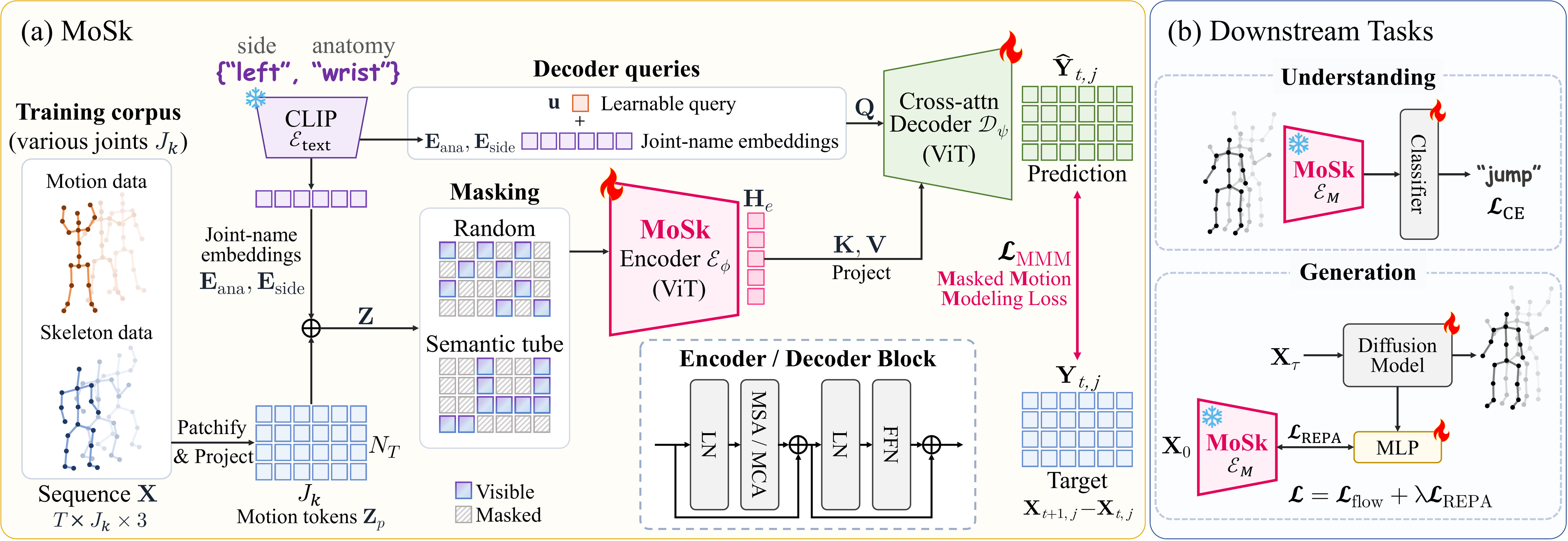
- 01Unified corpus. Motion and skeleton sequences are converted to 3D joint positions in one coordinate frame and sampled to 64 frames, each keeping its own joint set.
- 02Joint-name embeddings. A frozen CLIP text encoder embeds each joint’s anatomical name and side: a shared anatomical reference for the encoder inputs and the decoder queries.
- 03Masked motion modeling. With 90% of the tokens masked, a cross-attention decoder reconstructs joint velocities from the encoder’s features of the visible tokens.
BibTeX
@article{chen2026mosk,
  title={MoSk: A Unified Motion-Skeleton Foundation Model for Human Motion Understanding and Generation},
  author={Chen, Yun and Kim, Munchurl and Do, Jeonghyeok},
  journal={arXiv preprint arXiv:XXXX.XXXXX},
  year={2026}
}@article{do2026sofa,
title={One for All: Generalist Foundation Model for Cross-Sensor Skeleton Representation Learning},
author={Do, Jeonghyeok and Chen, Yun and Kim, Munchurl},
journal={arXiv preprint arXiv:2609.07078},
year={2026}
}