More research

MotionGrounder Grounded Multi-Object Motion Transfer via Diffusion Transformer

VICLab, KAIST, South Korea Adobe Research, California CMLab, Chung-Ang University, South Korea

{sateodoro, cyruby, agusgun, mkimee}@kaist.ac.kr sooyek@adobe.com jihyongoh@cau.ac.kr
†Co-Corresponding Authors
VICLab KAIST Adobe CMLab Chung-Ang University

NeurIPS 2026

MotionGrounder is a Diffusion Transformer-based framework that transfers motion from reference videos to newly synthesized videos with explicit object grounding, enabling object-consistent motion transfer with structural and appearance changes in a training-free, zero-shot manner.

Reference Video
MotionGrounder

“A caterpillar is crawling across a rough gray surface.”

Abstract

Motion transfer enables controllable video generation by transferring temporal dynamics from a reference video to synthesize a new video conditioned on a target caption. However, existing Diffusion Transformer (DiT)–based methods are limited to single-object videos, restricting fine-grained control in real-world scenes with multiple objects. In this work, we introduce MotionGrounder, a DiT-based framework that firstly handles motion transfer with multi-object controllability. Our Flow-based Motion Signal (FMS) in MotionGrounder provides a stable motion prior for target video generation, while our Object-Caption Alignment Loss (OCAL) grounds object captions to their corresponding spatial regions. We further propose a new Object Grounding Score (OGS), which jointly evaluates (i) spatial alignment between source video objects and their generated counterparts and (ii) semantic consistency between each generated object and its target caption. Our experiments show that MotionGrounder consistently outperforms recent baselines across quantitative, qualitative, and human evaluations.

Motivation

Existing motion transfer methods struggle with multi-object dynamics, often relying on costly inversion processes or lacking explicit grounding between objects and their corresponding target captions. While recent DiT-based approaches offer zero-shot capabilities, current patch trajectory-based methods (PTBM) extract noisy motion signals that hinder precise control over complex scenes. To address these gaps, MotionGrounder introduces a unified, inversion-free framework that enables stable motion transfer and grounded multi-object control across distinct spatial regions.

MethodDiT-basedWithout inversionMulti-objectObject groundingPTBM
DMT [1]Limited
MOFT [2]Limited
MotionClone [3]Limited
MotionFlow [4]Limited
ConMo [5]
RoPECraft [6]Limited
FlowMotion [7]Limited
MultiMotion [8] Noisy
DiTFlow [9]Limited Noisy
MotionGrounder (Ours) Stable
Comparison of motion transfer methods highlighting key limitations of prior works. Motion signal quality is reported only for patch trajectory-based methods (PTBM).

Method

Overall Framework

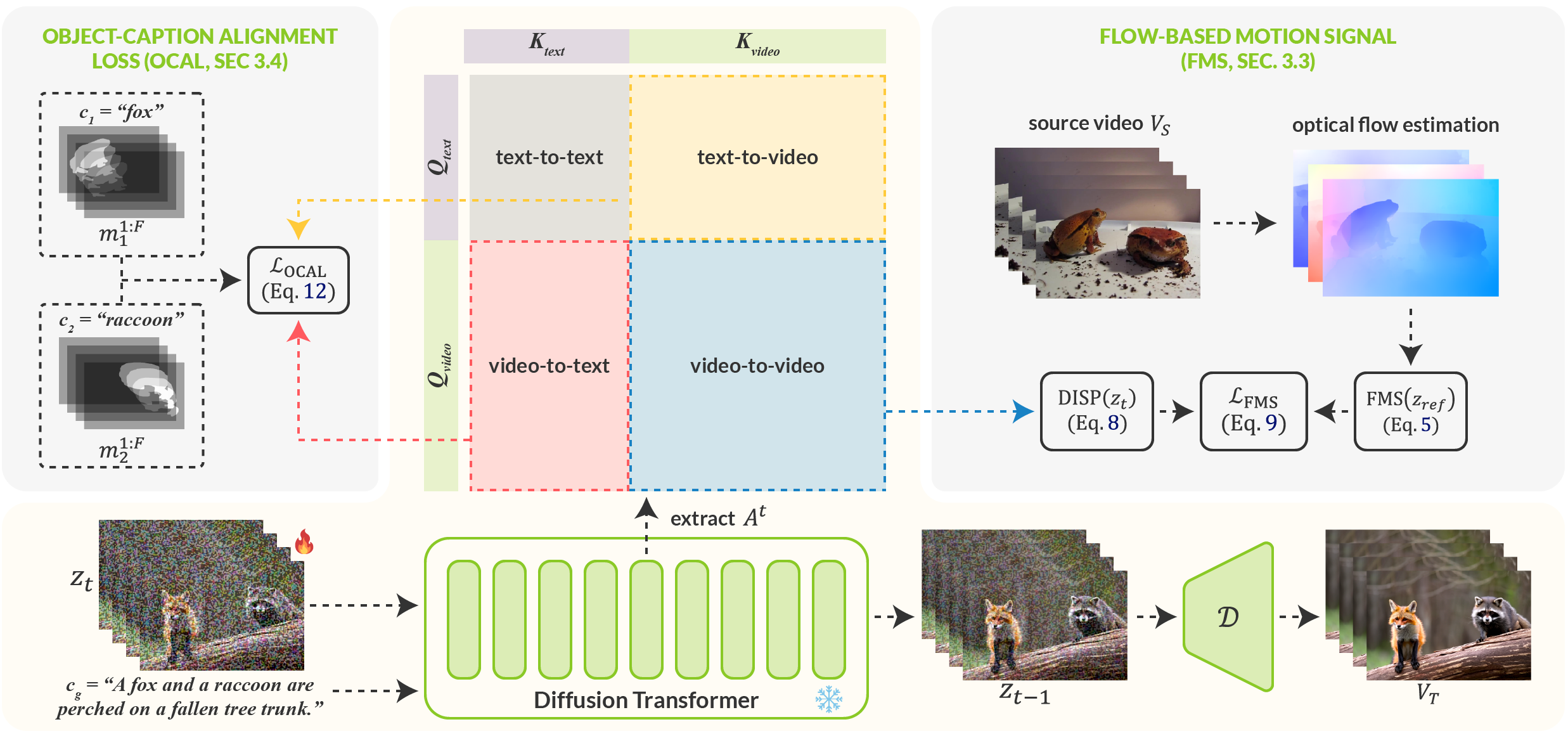
MotionGrounder transfers motion dynamics from a source video to a target video while grounding each object caption to its designated spatial region. By estimating optical flow, we construct a Flow-based Motion Signal (FMS) that serves as a representation of the source video's motion dynamics. During denoising, the FMS aligns the motion of the target video with the source. Simultaneously, our Object-Caption Alignment Loss (OCAL) ensures that individual object captions are grounded within their designated spatial regions across the entire video duration.

MotionGrounder method overview

Flow-based Motion Signal (FMS)

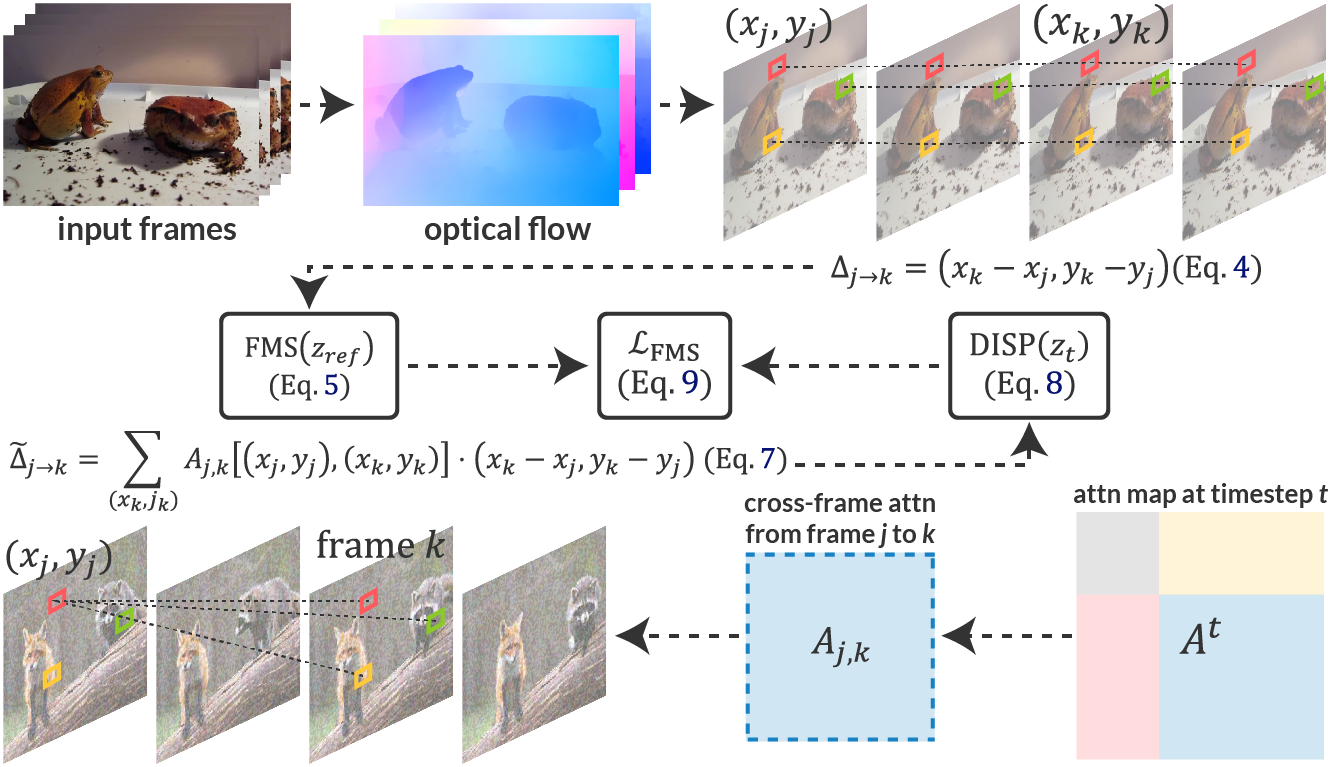
Our Flow-based Motion Signal (FMS) provides a stable motion prior by constructing latent-space patch trajectories from dense optical flows. During denoising, motion transfer is supervised by minimizing the distance between the reference FMS and the displacements derived from cross-frame attention weights.

Flow-based Motion Signal (FMS)

Object-Caption Alignment Loss (OCAL)

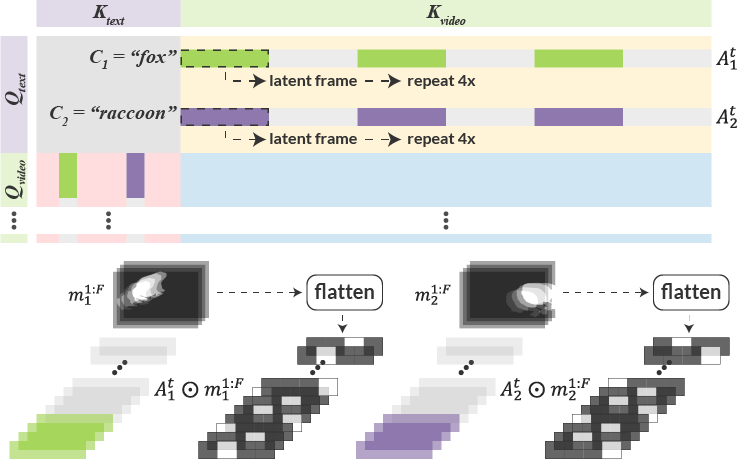
Our Object-Caption Alignment Loss (OCAL) enforces spatial grounding by aligning text-to-video and video-to-text attention with specific object masks during the denoising process. By simultaneously maximizing attention within the target region and suppressing it elsewhere, the objective ensures proper multi-object placement.

Object-Caption Alignment Loss (OCAL)

Dataset Generation Pipeline

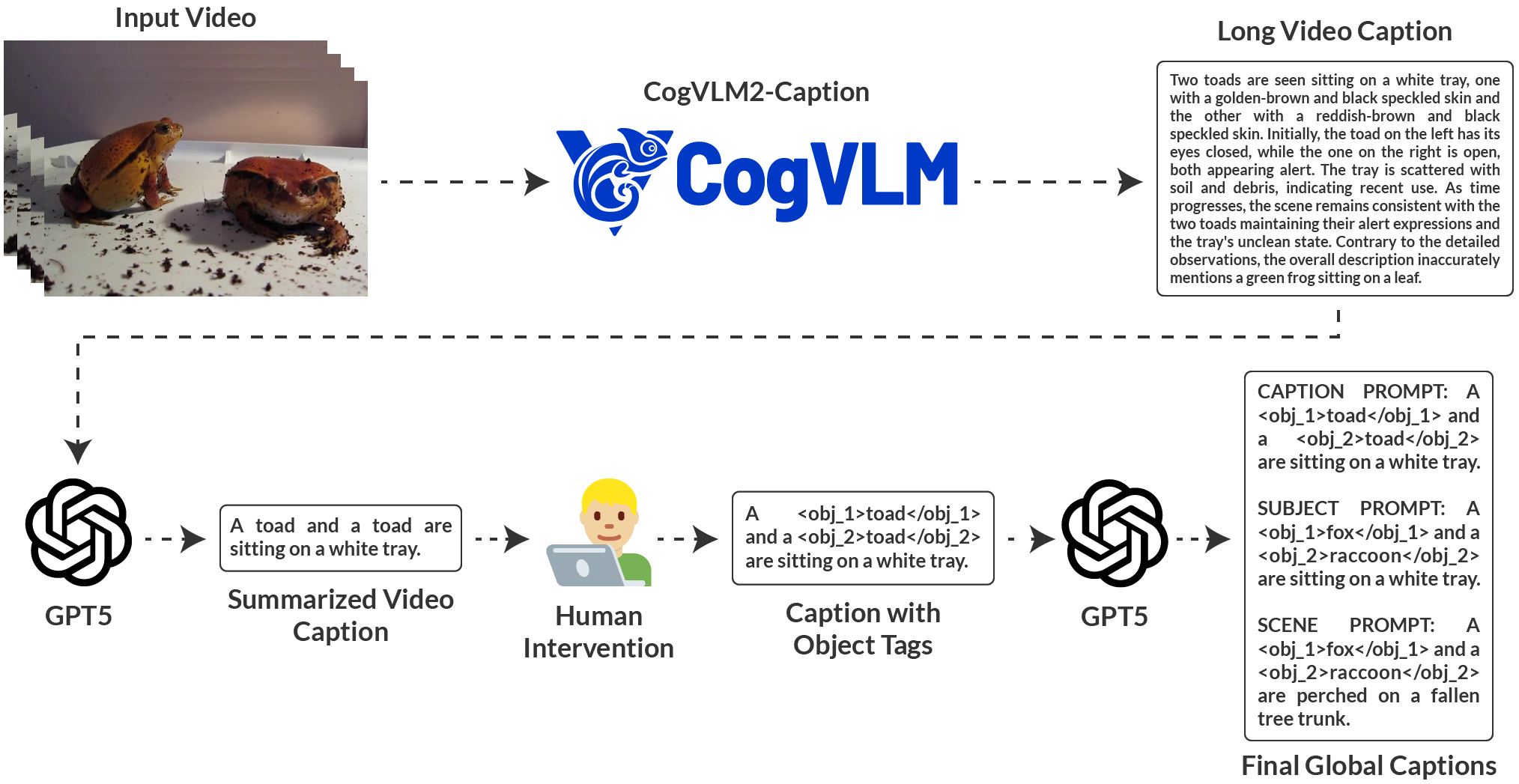
To support multi-object evaluation, we constructed a custom dataset of 52 videos, pre-processed into 24-frame sequences at 480 × 720 resolution. Our pipeline utilizes CogVLM2-Caption and GPT-5 to generate and structure captions into a <subject> <verb> <scene> format, where every described object in the <subject> is manually mapped to its corresponding mask. To evaluate model robustness, we generate three prompt types: (i) a Caption prompt that directly describes the input video content; (ii) a Subject prompt that alters the main objects while preserving the original background; and (iii) a Scene prompt that specifies an entirely new scene distinct from the source video.

Dataset generation pipeline

Results

Additional Applications

Interchangeable Generation

Reference Video
“A fox and a raccoon are perched on a fallen tree trunk.”
“A raccoon and a fox are perched on a fallen tree trunk.”

Object Removal

“A raccoon is perched on a fallen tree trunk.”
“A fox is perched on a fallen tree trunk.”
“A fallen tree trunk.”

References

  1. Danah Yatim, Rafail Fridman, Omer Bar-Tal, Yoni Kasten, and Tali Dekel. Space-Time Diffusion Features for Zero-Shot Text-Driven Motion Transfer. CVPR, 2024.
  2. Zeqi Xiao, Yifan Zhou, Shuai Yang, and Xingang Pan. Video Diffusion Models are Training-free Motion Interpreter and Controller. NeurIPS, 2024.
  3. Pengyang Ling, Jiazi Bu, Pan Zhang, Xiaoyi Dong, Yuhang Zang, Tong Wu, Huaian Chen, Jiaqi Wang, and Yi Jin. MotionClone: Training-Free Motion Cloning for Controllable Video Generation. ICLR, 2025.
  4. Tuna Han Salih Meral, Hidir Yesiltepe, Connor Dunlop, and Pinar Yanardag. MotionFlow: Attention-Driven Motion Transfer in Video Diffusion Models. AAAI, 2026.
  5. Jiayi Gao, Zijin Yin, Changcheng Hua, Yuxin Peng, Kongming Liang, Zhanyu Ma, Jun Guo, and Yang Liu. ConMo: Controllable Motion Disentanglement and Recomposition for Zero-Shot Motion Transfer. CVPR, 2025.
  6. Ahmet Berke Gokmen, Yigit Ekin, Bahri Batuhan Bilecen, and Aysegul Dundar. RoPECraft: Training-Free Motion Transfer with Trajectory-Guided RoPE Optimization on Diffusion Transformers. NeurIPS, 2025.
  7. Zhen Wang, Youcan Xu, Jun Xiao, and Long Chen. FlowMotion: Training-Free Flow Guidance for Video Motion Transfer. CVPR, 2026.
  8. Penghui Liu, Jiangshan Wang, Yutong Shen, Shanhui Mo, Chenyang Qi, and Yue Ma. MultiMotion: Multi Subject Video Motion Transfer via Video Diffusion Transformer. AAAI, 2026.
  9. Alexander Pondaven, Aliaksandr Siarohin, Sergey Tulyakov, Philip Torr, and Fabio Pizzati. Video Motion Transfer with Diffusion Transformers. CVPR, 2025.

BibTeX

@inproceedings{teodoro2026motiongrounder,    title={MotionGrounder: Grounded Multi-Object Motion Transfer via Diffusion Transformer},    author={Samuel Teodoro and Yun Chen and Agus Gunawan and Soo Ye Kim and Jihyong Oh and Munchurl Kim},    booktitle={Advances in Neural Information Processing Systems (NeurIPS)},    year={2026}}