
Choose the codec, train from scratch
A SAR–EO reconstruction audit selects the codec; a substantially smaller DiT is trained from scratch in its latent space.
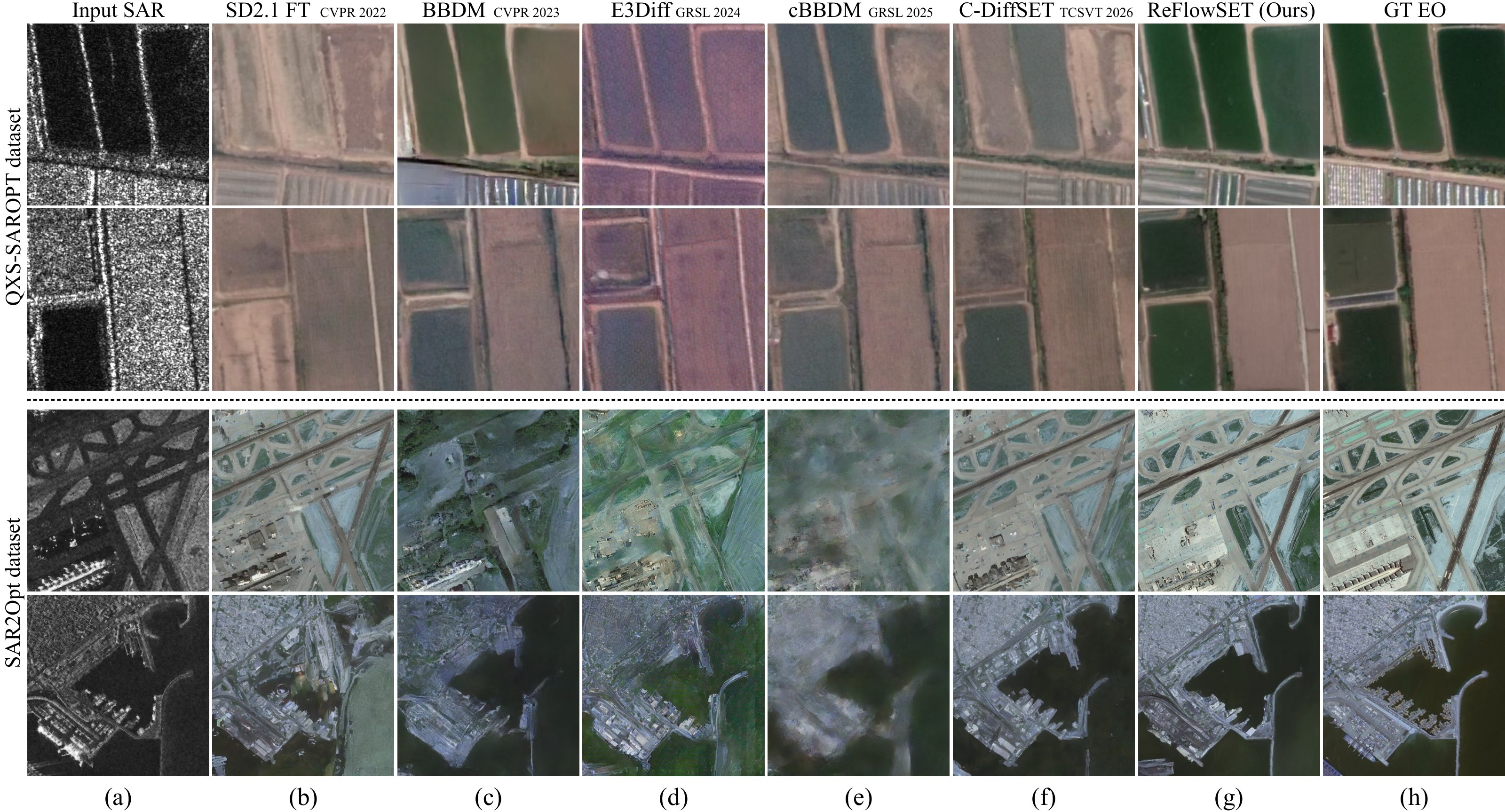
Same SAR input, every method
Five retrained baselines and ReFlowSET at the native resolution of the paper’s tiles. Select a tile to compare it with the ground truth.
Use the arrows or the ← → keys to change scene · click a tile to open the comparison sliderSwipe or use the arrows to change scene · tap a tile to open the comparison slider
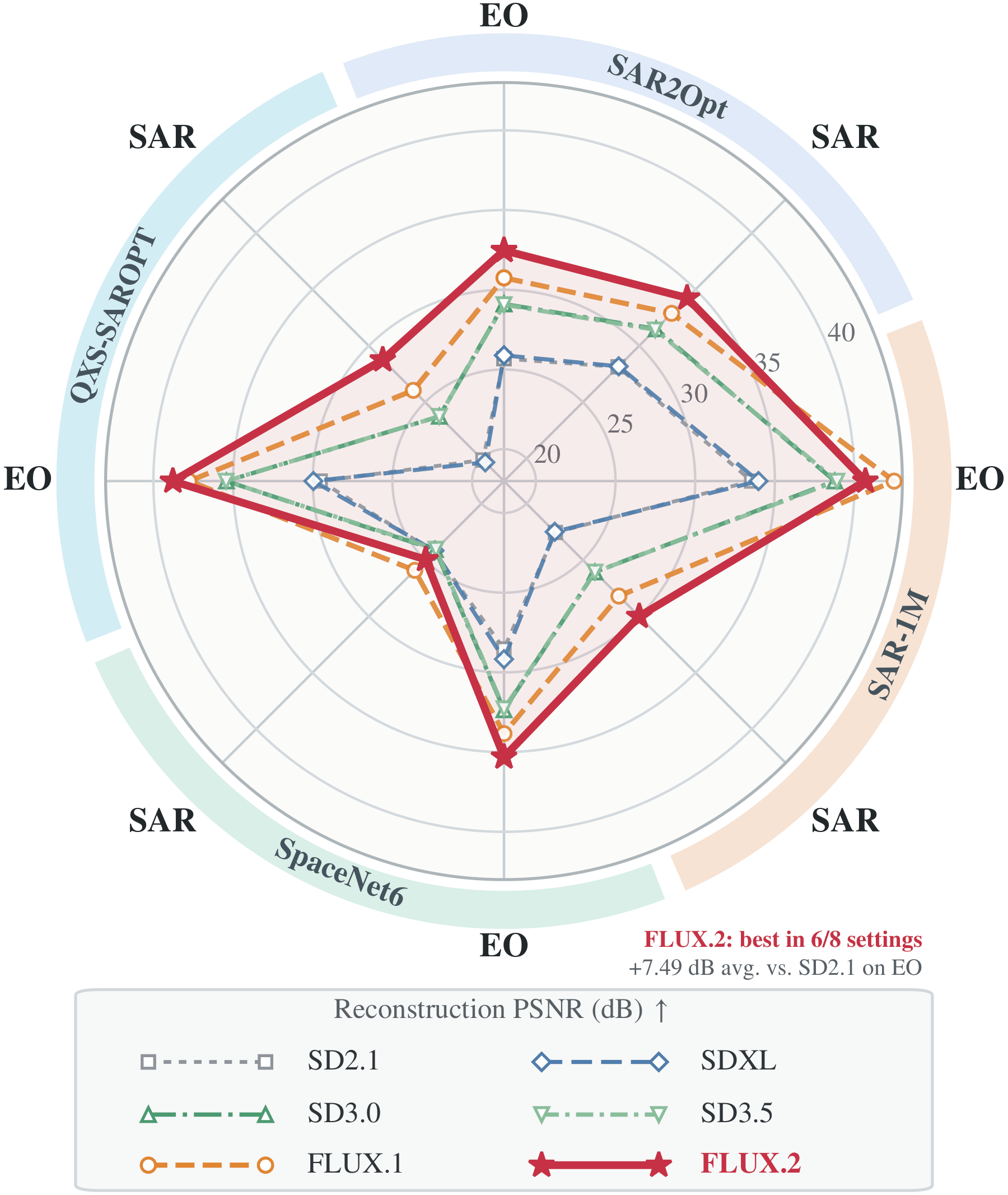
The codec sets the ceiling
Encode–decode PSNR of six pretrained autoencoders on four SAR–EO datasets: FLUX.2 is best in six of eight dataset–modality settings and raises the mean EO ceiling by 7.49 dB over SD2.1.
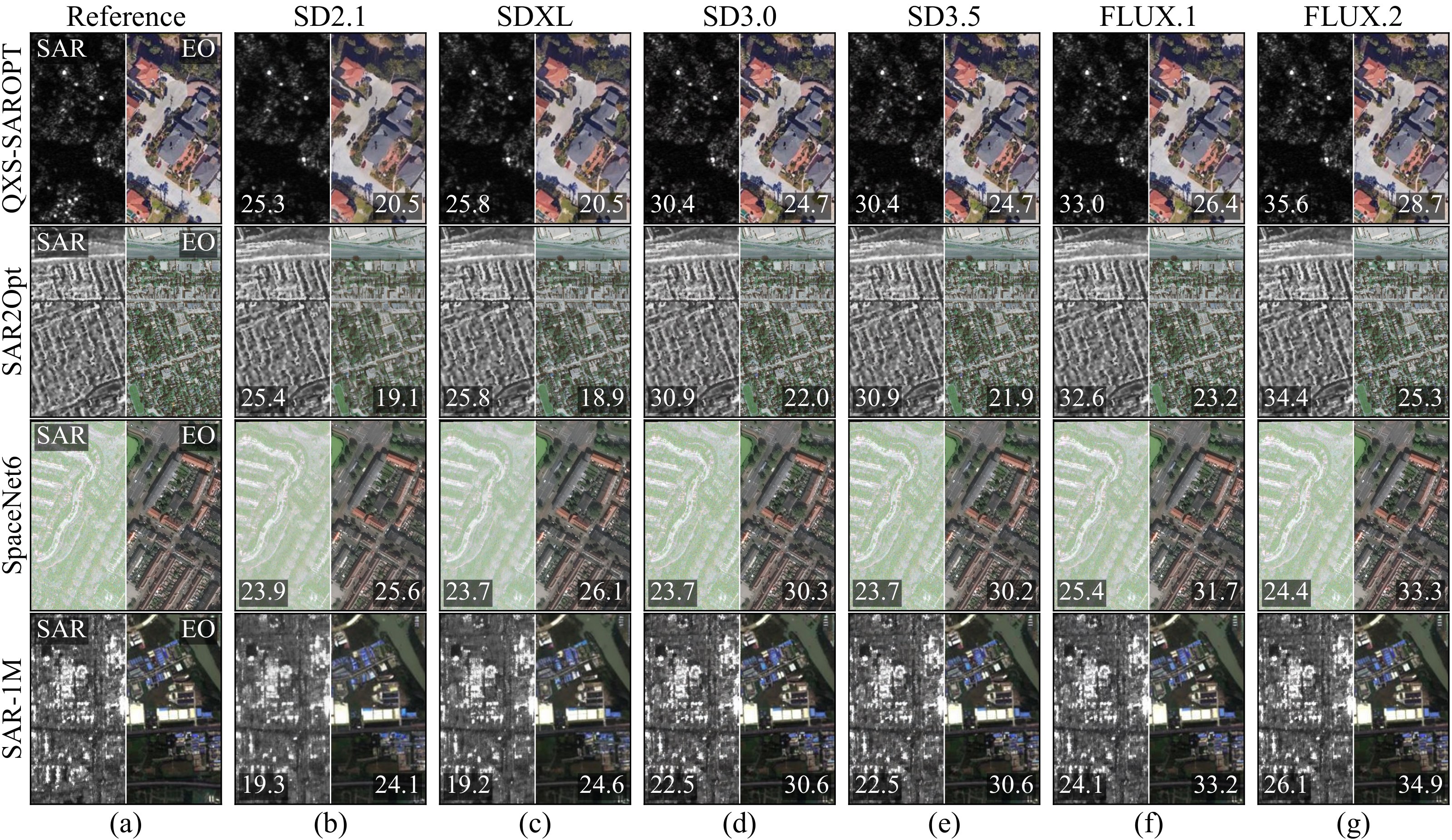
Within ReFlowSET, replacing the SD2.1 codec with FLUX.2 improves all five metrics on both benchmarks: FID 25.5 → 19.1 on QXS-SAROPT and 84.5 → 66.3 on SAR2Opt (Table 1).
Quantitative results
ReFlowSET achieves the best FID and DISTS on both benchmarks and the best LPIPS on SAR2Opt.
| Method | Venue | QXS-SAROPT | SAR2Opt | ||||||||
|---|---|---|---|---|---|---|---|---|---|---|---|
| FID↓ | DISTS↓ | LPIPS↓ | SSIM↑ | PSNR↑ | FID↓ | DISTS↓ | LPIPS↓ | SSIM↑ | PSNR↑ | ||
| General image translation/restoration methods | |||||||||||
| pix2pix | CVPR'17 | 174.6 | 0.373 | 0.665 | 0.203 | 12.33 | 261.9 | 0.347 | 0.657 | 0.199 | 13.39 |
| CycleGAN | ICCV'17 | 104.4 | 0.376 | 0.653 | 0.262 | 12.92 | 143.5 | 0.330 | 0.650 | 0.178 | 12.90 |
| pix2pixHD | CVPR'18 | 85.7 | 0.298 | 0.573 | 0.358 | 16.13 | 146.3 | 0.283 | 0.567 | 0.268 | 15.95 |
| SPADE | CVPR'19 | 90.7 | 0.292 | 0.599 | 0.320 | 14.53 | 142.5 | 0.265 | 0.597 | 0.234 | 14.47 |
| DDPM (SR3) | TPAMI'22 | 43.8 | 0.311 | 0.620 | 0.359 | 14.04 | 122.5 | 0.295 | 0.610 | 0.313 | 13.65 |
| SD2.1 fine-tune | CVPR'22 | 19.1 | 0.257 | 0.561 | 0.348 | 15.40 | 71.8 | 0.211 | 0.541 | 0.293 | 16.24 |
| BBDM | CVPR'23 | 76.6 | 0.270 | 0.568 | 0.352 | 15.34 | 143.1 | 0.290 | 0.590 | 0.276 | 15.29 |
| ControlNet | ICCV'23 | 50.4 | 0.307 | 0.604 | 0.297 | 13.42 | 140.5 | 0.350 | 0.643 | 0.217 | 11.73 |
| ResShift | NeurIPS'23 | 140.2 | 0.334 | 0.607 | 0.217 | 14.20 | 141.7 | 0.304 | 0.597 | 0.177 | 14.31 |
| HI-Diff | NeurIPS'23 | 324.3 | 0.539 | 0.692 | 0.457 | 17.10 | 319.8 | 0.473 | 0.692 | 0.384 | 17.36 |
| StegoGAN | CVPR'24 | 106.8 | 0.384 | 0.658 | 0.254 | 12.96 | 150.1 | 0.347 | 0.655 | 0.158 | 12.47 |
| SAR-to-EO methods | |||||||||||
| Cond. Diffusion | GRSL'23 | 88.6 | 0.355 | 0.730 | 0.213 | 11.55 | 211.8 | 0.415 | 0.686 | 0.248 | 12.48 |
| E3Diff | GRSL'24 | 47.8 | 0.278 | 0.530 | 0.302 | 16.44 | 104.7 | 0.232 | 0.529 | 0.249 | 16.09 |
| cBBDM | GRSL'25 | 50.6 | 0.246 | 0.539 | 0.372 | 16.02 | 222.3 | 0.377 | 0.571 | 0.361 | 17.05 |
| C-DiffSET | TCSVT'26 | 19.9 | 0.233 | 0.526 | 0.380 | 16.92 | 78.1 | 0.214 | 0.529 | 0.314 | 16.81 |
| ReFlowSET (SD2.1) | – | 25.5 | 0.267 | 0.566 | 0.337 | 15.85 | 84.5 | 0.217 | 0.541 | 0.270 | 15.82 |
| ReFlowSET (Ours) | – | 19.1 | 0.231 | 0.534 | 0.355 | 16.09 | 66.3 | 0.185 | 0.522 | 0.287 | 16.06 |
On SAR2Opt, ReFlowSET lowers the second-best FID from 71.8 to 66.3 and DISTS from 0.211 to 0.185, relative gains of 7.7% and 12.3%. Checkpoints of the retrained baselines are on Hugging Face.
Ablation and efficiency Table 2
| ℒRe | SAR Stream |
Fusion | Topology | FID↓ | Params↓ (M) |
VRAM↓ (GB) |
Time↓ (sec) |
|---|---|---|---|---|---|---|---|
| ✓ | Shared [C-DiffSET] | Input [C-DiffSET] | 0D+12S | 72.865 | 108.46 | 8.18 | 0.92 |
| ✓ | Dual | Token | 4D+8S | 70.450 | 143.86 | 13.57 | 2.06 |
| ✗ | Dual | Channel | 4D+8S | 71.851 | 145.04 | 9.80 | 1.34 |
| ✓ | Dual | Channel | 4D+8S | 70.436 | 145.04 | 10.63 | 1.34 |
With alignment enabled, the dedicated SAR stream with channel fusion lowers FID from 72.865 to 70.436; token fusion gives virtually no FID benefit (70.450) at higher VRAM and latency. Adding ℒRe lowers FID from 71.851 to 70.436 with unchanged parameters and latency.
Fuse late, align only in training
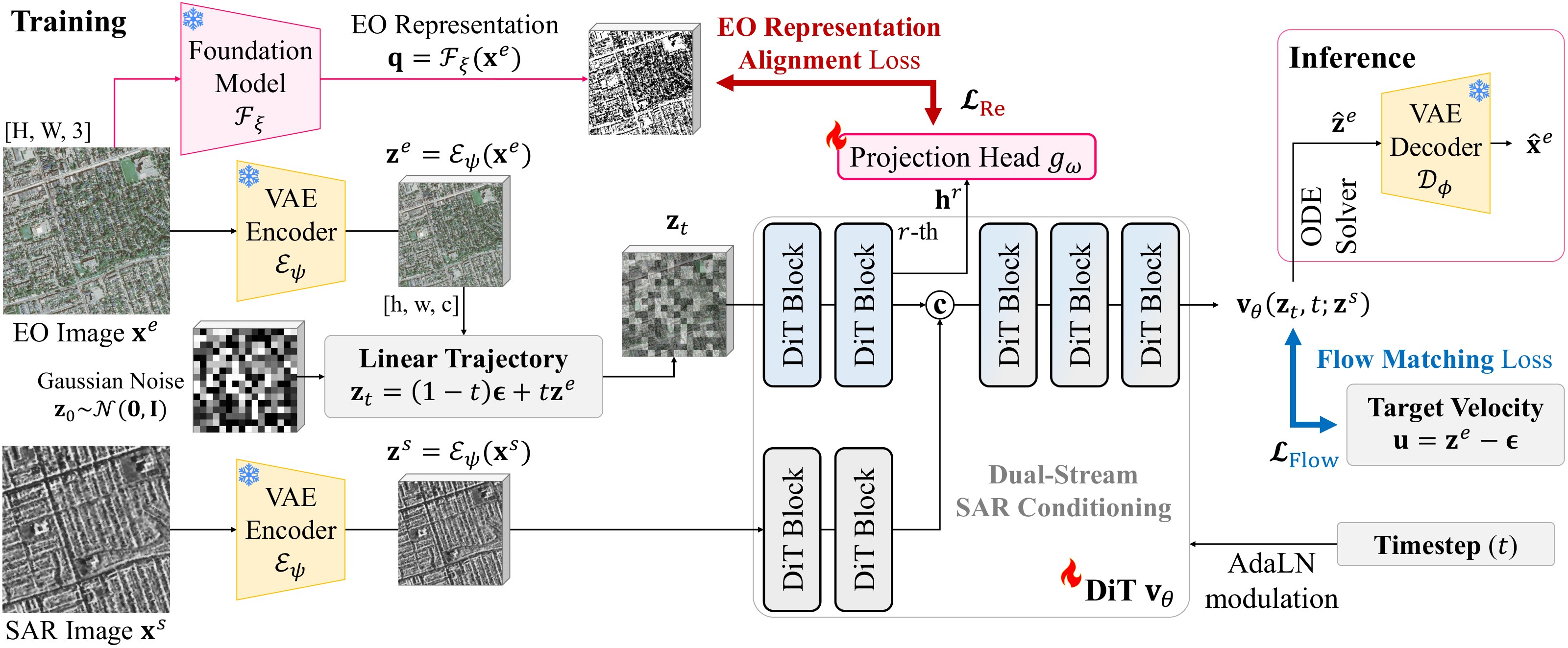
- 01Codec chosen by reconstruction. Frozen FLUX.2 latents for SAR and EO; a 509.3M-parameter DiT is trained from scratch.
- 02Dual-stream SAR conditioning. SAR and noisy-EO latents stay separate for 8 of 24 blocks, then fuse channel-wise.
- 03Training-only alignment. Noisy-EO features are aligned with clean-EO DINOv3 features, at no inference cost.
BibTeX
@article{do2026reflowset,
  title={ReFlowSET: Representation-Aligned Latent Flow Matching for SAR-to-EO Image Translation},
  author={Do, Jeonghyeok and Lee, Seungchul and Kim, Munchurl},
  journal={arXiv preprint arXiv:2609.00968},
  year={2026}
}@article{do2026cdiffset,
title={C-diffset: Leveraging latent diffusion for sar-to-eo image translation with confidence-guided reliable object generation},
author={Do, Jeonghyeok and Lee, Jaehyup and Lee, Seungchul and Kim, Munchurl},
journal={IEEE Transactions on Circuits and Systems for Video Technology},
year={2026},
publisher={IEEE}
}